Specters of Marx by Jacques Derrida
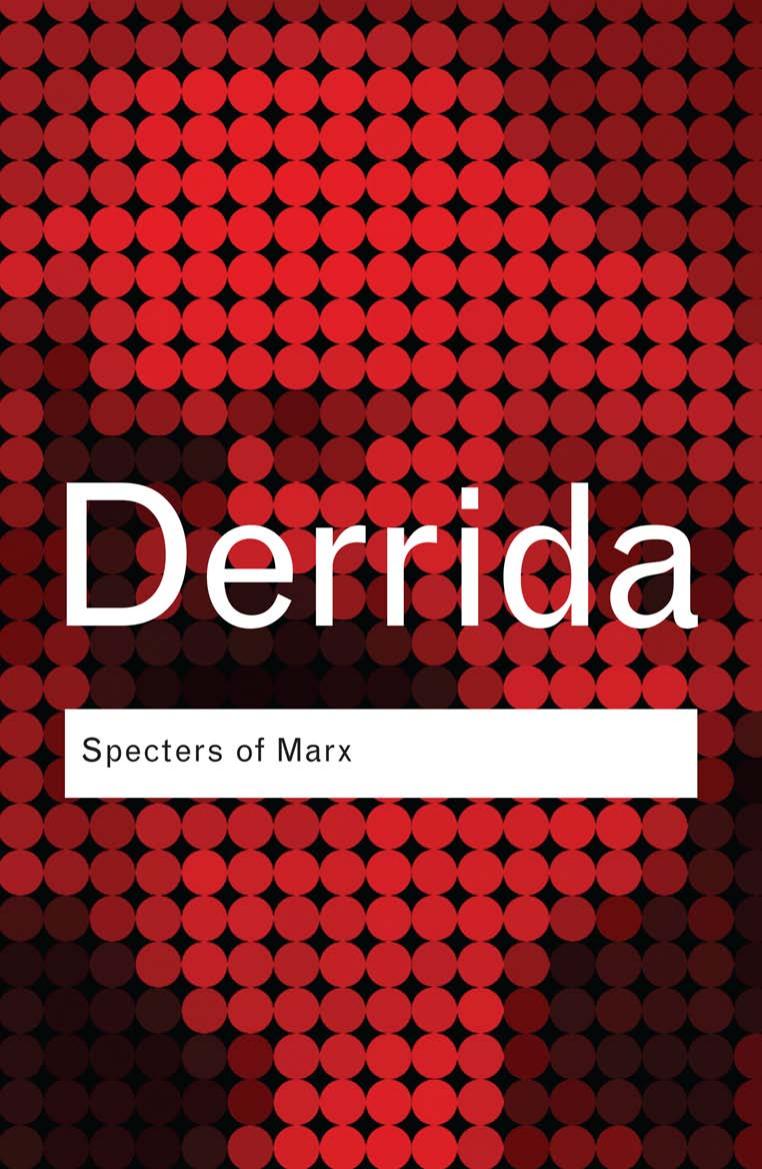
Author:Jacques Derrida
Language: eng
Format: epub, pdf
Publisher: Taylor & Francis
5
Apparition of the Inapparent
The phenomenological “conjuring trick”
An articulation assures the movement of this relentless indictment. It gives some play. It plays between the spirit (Geist) and the specter (Gespenst), between the spirit on the one hand, the ghost or the revenant on the other. This articulation often remains inaccessible, eclipsed in its turn in shadow, where it moves about and puts one offthe trail. First of all, let us once again underscore that Geist can also mean specter, as do the words “esprit” or “spirit.” The spirit is also the spirit of spirits. Next, The German Ideology uses and abuses this equivocation. It is its principal weapon. And especially, although it operates with constancy or consistency, and even if it is less tenable than Marx himself thinks, the argument that permits him to distinguish between spirit and specter remains discreet and subtle. The specter is of the spirit, it participates in the latter and stems from it even as it follows it as its ghostly double. The difference between the two is precisely what tends to disappear in the ghost effect, just as the concept of such a difference or the argumentative movement that puts it to work in the rhetoric tends to vanish. All the more so in that this rhetoric is in advance devoted to the polemic, in any case to the strategy of a hunt or chase [une chasse]. And even to a counter-sophistics that at every moment runs the risk of replicating the reply: reproducing in a mirror the logic of the adversary at the moment of the retort, piling it on there where one accuses the other of abusing language. This counter-sophistics (Marx as paradoxical heir of Plato, as we shall see) has to manipulate simulacra, mimemes, phantasms. It has to watch out for, so as to denounce, the maneuvers of an illusionist, the “conjuring tricks” of a prestidigitator of the concept, or the sleights of hand of a nominalist rhetor.
We can try to grasp this strategy as close as possible to its literality, and first of all its Stirnerian literality, in what Marx calls the series of “conjuring tricks” (French: escamotage; German, Eskamotage), which he intends to take apart at the beginning of “Saint Max” (“The Leipzig Council III”).1 The production of the ghost, the constitution of the ghost effect is not simply a spiritualization or even an autonomization of spirit, idea, or thought, as happens par excellence in Hegelian idealism. No, once this autonomization is effected, with the corresponding expropriation or alienation, and only then, the ghostly moment comes upon it, adds to it a supplementary dimension, one more simulacrum, alienation, or expropriation. Namely, a body! In the flesh (Leib)! For there is no ghost, there is never any becoming-specter of the spirit without at least an appearance of flesh, in a space of invisible visibility, like the dis-appearing of an apparition. For there to be ghost, there must be a return to the body, but to a body that is more abstract than ever.
Download
This site does not store any files on its server. We only index and link to content provided by other sites. Please contact the content providers to delete copyright contents if any and email us, we'll remove relevant links or contents immediately.
| Anthropology | Archaeology |
| Philosophy | Politics & Government |
| Social Sciences | Sociology |
| Women's Studies |
The Secret History by Donna Tartt(19104)
The Social Justice Warrior Handbook by Lisa De Pasquale(12197)
Thirteen Reasons Why by Jay Asher(8919)
This Is How You Lose Her by Junot Diaz(6894)
Weapons of Math Destruction by Cathy O'Neil(6285)
Zero to One by Peter Thiel(5808)
Beartown by Fredrik Backman(5768)
The Myth of the Strong Leader by Archie Brown(5513)
The Fire Next Time by James Baldwin(5454)
How Democracies Die by Steven Levitsky & Daniel Ziblatt(5225)
Promise Me, Dad by Joe Biden(5157)
Stone's Rules by Roger Stone(5091)
A Higher Loyalty: Truth, Lies, and Leadership by James Comey(4967)
100 Deadly Skills by Clint Emerson(4932)
Rise and Kill First by Ronen Bergman(4797)
Secrecy World by Jake Bernstein(4756)
The David Icke Guide to the Global Conspiracy (and how to end it) by David Icke(4724)
The Farm by Tom Rob Smith(4517)
The Doomsday Machine by Daniel Ellsberg(4493)
